> For the complete documentation index, see [llms.txt](https://docs.sonarsource.com/llms.txt). Markdown versions of documentation pages are available by appending `.md` to page URLs; this page is available as [Markdown](https://docs.sonarsource.com/sonarqube-for-vs-code/connect-your-ide/advanced-configuration.md).
# Advanced configuration
Some network infrastructures require custom setups to let SonarQube for IDE perform HTTP requests. Here are the properties that will help make this happen.
## HTTP configuration
To operate, SonarQube for VS Code needs to perform HTTP requests, especially in [Connected mode](/sonarqube-for-intellij/connect-your-ide/connected-mode.md). While SonarQube for VS Code will work out-of-the-box in most situations, some network infrastructure may require a custom configuration.
## Passing SonarQube for IDE properties
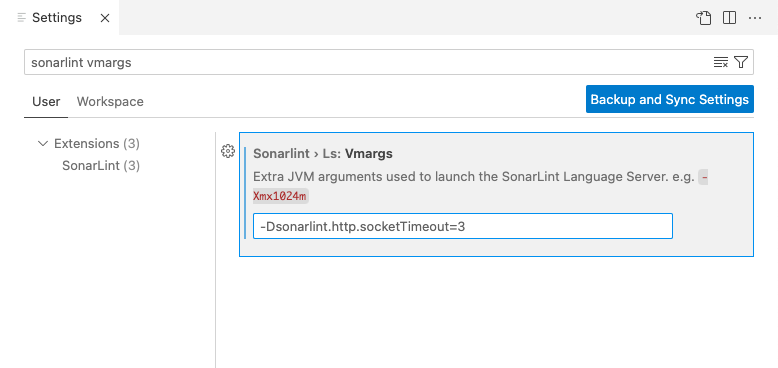
In SonarQube for VS Code, open the extension settings, and add your properties to the **Settings** > **Extensions** > **Sonarlint** > **Ls: Vmargs** JVM arguments.
## Proxy configuration
To use connected mode with a SonarQube instance running behind a proxy, pass your settings using the JVM arguments as referenced above in [#passing-sonarlint-properties](#passing-sonarlint-properties "mention").
For example, you might add these arguments:
```json
{ "sonarlint.ls.vmargs": "-Dhttps.proxyHost= -Dhttps.proxyPort=8080 -Dhttps.nonProxyHosts=localhost|127.0.0.1|" }
```
## Manage your configuration
### HTTP Client timeouts
SonarQube for IDE supports various timeouts. Below you will find the properties added to control them:
`sonarlint.http.connectTimeout`
* Determines the timeout, in minutes, until a new connection is fully established.
* **Default**: 1 min
`sonarlint.http.socketTimeout`
* Determines the default socket timeout value, in minutes, for I/O operations.
* **Default**: infinite
`sonarlint.http.connectionRequestTimeout`
* The connection lease request timeout, in minutes, is used when requesting a connection from the connection manager.
* **Default**: 1 min
`sonarlint.http.responseTimeout`
* Determines the timeout, in minutes, until the arrival of a response from the opposite endpoint.
* **Default**: 10 min
### Server SSL certificates
SonarQube for IDE manages its own TrustStore in addition to the OS and Java TrustStores. When encountering an untrusted certificate, SonarQube for IDE will ask the user if the certificate should be trusted. If the answer is yes, the certificate will be added to the TrustStore.
SonarQube for IDE depends on you to provide server certificates when required by your environment. Here’s a generalization of a few basic steps you can use to help make that easier. Note that these instructions are for *server SSL certificates*. If you're dealing with a *client SSL certificate*, you'll need to create and configure a "key store" instead.
{% hint style="info" %}
SonarQube for IDE was previously named SonarLint. The SSL property names, default paths, and default passwords on this page keep the earlier name.
{% endhint %}
Install a server SSL certificate
**To install a server SSL certificate**
**Step 1:** Import your certificate into SonarQube for IDE. Here is a common command to import your certificate (`.cer`) into a TrustStore (`C:/`):
```bash
keytool -import -keystore C:/ -storepass password -noprompt -alias sonarqube-ssl -file .cer
```
* Replace `C:/` with your desired path and `password` with your chosen TrustStore password.
**Step 2:** Now that you’ve created the file, tell VS Code where to find it by adding these lines to your JVM arguments. See the [#passing-sonarlint-properties](#passing-sonarlint-properties "mention") instructions for more details.
```bash
-Dsonarlint.ssl.trustStorePath=C:/
-Dsonarlint.ssl.trustStorePassword=
-Dsonarlint.ssl.trustStoreType=PKCS12
```
* Check that your path and password match what you used for your TrustStore.
**Step 3:** Restart your IDE.
**TrustStore**
**sonarlint.ssl.trustStorePath**
* Path to the keystore used by SonarQube for VS Code to store custom trusted server certificates
* **default**: `~/.sonarlint/ssl/truststore.p12`
**sonarlint.ssl.trustStorePassword**
* Password of the truststore.
* **default**: `sonarlint`
**sonarlint.ssl.trustStoreType**
* The format of the keystore file is found in the [Oracle documentation](https://docs.oracle.com/en/java/javase/17/docs/specs/security/standard-names.html#keystore-types).
* **default**: `PKCS12`
### Client SSL certificates
Some servers or proxies may also require SonarQube for IDE to authenticate using client-side SSL certificates. This is a rare use case, and at for the moment, there is no UI to configure client-side SSL certificates. To properly authenticate client-side SSL certificates, you must manually create a keystore at the default location, or use the following properties:
**KeyStore**
**sonarlint.ssl.keyStorePath**
* Path to the keystore used by SonarQube for IDE to store client certificates.
* **default**: `~/.sonarlint/ssl/keystore.p12`
**sonarlint.ssl.keyStorePassword**
* Password of the keystore.
* **default**: `sonarlint`
**sonarlint.ssl.keyStoreType**
* The format of the keystore file is found in the [Oracle documentation](https://docs.oracle.com/en/java/javase/17/docs/specs/security/standard-names.html#keystore-types).
* **default**: `PKCS12`
---
# Agent Instructions
This documentation is published with GitBook. GitBook is the documentation platform designed so that both humans and AI agents can read, navigate, and reason over technical content effectively. Learn more at gitbook.com.
## Querying This Documentation
If you need additional information that is not directly available in this page, you can query the documentation by asking a question.
Perform an HTTP GET request on the following URL with the `ask` and `goal` query parameters:
```
GET https://docs.sonarsource.com/sonarqube-for-vs-code/connect-your-ide/advanced-configuration.md?ask=&goal=
```
`ask` is the immediate question: it should be specific, self-contained, and written in natural language.
`goal` is what the user is ultimately trying to achieve, the reason they need the answer. Sharing it helps GitBook give you a better, more relevant answer. A goal is most helpful when it describes the outcome the user wants rather than restating the question. For example, with `ask=how do I create an API token`, a goal like `automate deployments from our CI pipeline` lets GitBook tailor the answer to that use case.
The response will contain a direct answer to the question and relevant excerpts and sources from the documentation.
Use this mechanism when the answer is not explicitly present in the current page, you need clarification or additional context, or you want to retrieve related documentation sections.