> For the complete documentation index, see [llms.txt](https://docs.sonarsource.com/llms.txt). Markdown versions of documentation pages are available by appending `.md` to page URLs; this page is available as [Markdown](https://docs.sonarsource.com/sonarqube-for-vs-code/using/fixing-issues.md).
# Fixing issues
How to fix issues in your IDE found by SonarQube for VS Code. When running in connected mode, fix issues found in SonarQube (Server, Cloud) by using the mechanisms that connect the SonarQube products.
Whether your issue is about *a potential security problem*, considered to be *a bad coding practice*, or *a more serious logic error*, fixing issues usually involves changes to the code. SonarQube for IDE’s issue messages contain useful information about how to fix the potential problem and include a rule description so that you can learn more about why the issue is reported.
SonarQube for VS Code offers multiple ways to investigate and fix problems in your code. Issues are usually presented in multiple locations and you can typically hover and/or click or right-click over these markers to open a tooltip that reveals your options. See the [Investigating issues](/sonarqube-for-vs-code/using/investigating-issues.md) page for more information about finding and identifying your issues.
Double-click an issue in the SonarQube for IDE view window to jump to and highlight the code in the explorer. Once the code is highlighted, you have more than one way to expose solutions and suggested quick fixes.
## Rule selection
Issues are reported when your code violates one or more of Sonar's rules. When running SonarQube for VS Code in standalone mode (ie: when you're *not in connected mode*), it's possible to locally manage which rules are used to find issues in your code. See the [Rules and languages](/sonarqube-for-vs-code/using/rules.md#using-sonar-rules) articles to learn what's possible.
If you simply want to toggle a rule, jump straight to the [Rules and languages](/sonarqube-for-vs-code/using/rules.md#edit-rules) article to learn how to turn Sonar rules on or off in your IDE.
{% hint style="info" %}
When a project is bound to a SonarQube project, the **RULES** view is not visible in the UI. In this case, the rules configuration from the server applies. For more information, see the server documentation about quality profiles to edit rules:
* [Managing quality profiles](/sonarqube-cloud/standards/managing-quality-profiles.md) in SonarQube Cloud
* [Managing quality profiles](/sonarqube-server/2026.1/quality-standards-administration/managing-quality-profiles.md) in SonarQube Server
{% endhint %}
## The Remediation Center
{% hint style="success" %}
This is a SonarQube for IDE Labs feature. Update your SonarQube for VS Code installation to the latest version, then sign up for IDE Labs to get early access to our newest features and help shape the future of SonarQube for IDE!
Open the **SONARQUBE FOR IDE LABS** panel from the right side of your **SONARQUBE** panel. See the [Investigating issues](/sonarqube-for-vs-code/using/investigating-issues.md#sonarqube-for-ide-labs) article for details.
{% endhint %}
SonarQube for VS Code's **REMEDIATION CENTER** panel displays remediation events originating in SonarQube Cloud and SonarQube Server. It's intended to give you a focused contextual view of an issue that you were investigating on the server. The event highlights that will be triggered in this panel are:
* When you use the [**Open in IDE**](/sonarqube-for-vs-code/using/investigating-issues.md#opening-issues-in-the-ide) button from the server, issues will open and be highlighted in your file.
* The [SonarQube Rule Description](/sonarqube-for-vs-code/using/investigating-issues.md#editor-groups) editor group will open in your IDE.
* When you use the **View fix in the IDE** button in [SonarQube Cloud](/sonarqube-cloud/managing-your-projects/issues/fixing.md#getting-ai-generated-fix-suggestions) and [SonarQube Server](/sonarqube-server/2026.1/user-guide/issues/fixing.md#getting-ai-generated-fix-suggestions), you'll get a summary of your [AI CodeFix](/sonarqube-for-vs-code/ai-capabilities/ai-codefix.md) fix suggestion and the opportunity to see a diff view before you accept the improvement.
* If your issue cannot be applied, your fix will be available as a markdown file designed for further investigation.
## Quick fixes
Some issues have Sonar Quick Fixes which means that with a single click, SonarQube for IDE will automatically edit your source code to comply with the rule description and fix the issue. Even when a Sonar Quick Fix is not available, SonarQube for IDE provides options in the tooltip to help you fix your code.
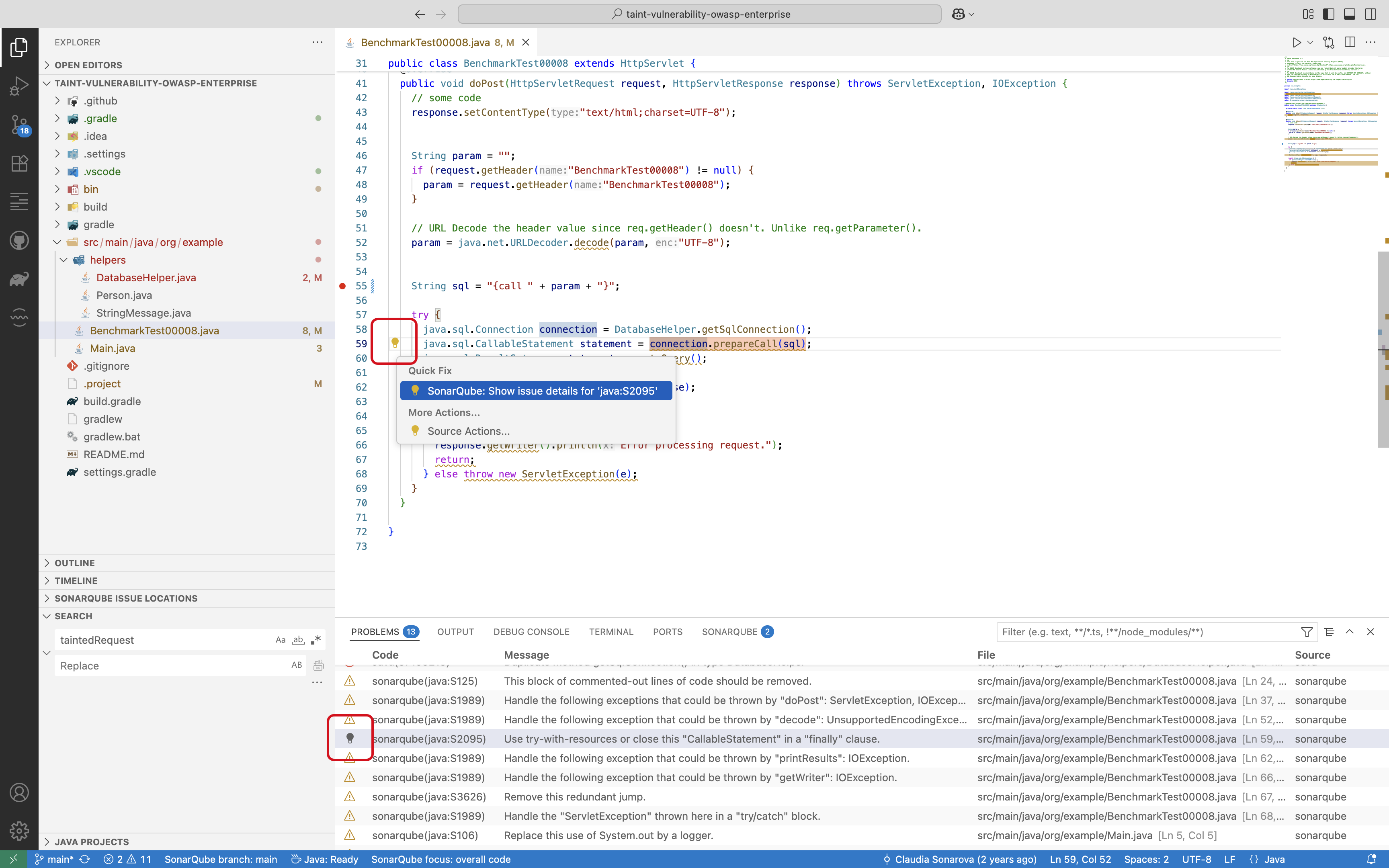
While in the explorer window, select the issue in the PROBLEMS view panel or click the lightbulb in the left margin of the VS Code editor to reveal the tooltip exposing one or more of these options:
* **✧˖° Fix with AI CodeFix**: AI CodeFix suggestions are available when running in connected mode with SonarQube (Server, Cloud). See the article about [AI CodeFix](/sonarqube-for-vs-code/ai-capabilities/ai-codefix.md#ai-codefix) for details.
* **Open description of rule**: opens a new view panel with the detailed rule description, which usually explains why the issue is raised and explains how to fix it.
* **Deactivate rule ‘yyy:XXX’**: This action disables the rule in the user’s VSCode settings and is only available when you are *not using Connected Mode*.
* To reactivate a rule, go to the **SONARQUBE SETUP** > **RULES** view in VS Code and click the 3-dots to select **Find Rule By Key**.
{% hint style="info" %}
If your code violates more than one rule, a set of options will be presented for each instance. An example is shown in the image below.
* SonarQube for VS Code calls out that your container is missing both CPU *and* memory limits with rules kubernetes:S6869 and kubernetes:S6864; the Maintainability and Security of your code is potentially affected.
{% endhint %}
## AI CodeFix in your IDE
If you’re running in connected mode with SonarQube Server or SonarQube Cloud, you might see the **✧˖°** icon which means that there is an AI-generated fix suggestion available. Please check the requirements for using [AI CodeFix](/sonarqube-for-vs-code/ai-capabilities/ai-codefix.md).
## Fixing injection vulnerabilities
**Injection vulnerabilities** (also called taint vulnerabilities) are [Security-related rules](/sonarqube-cloud/standards/managing-rules/security-related-rules.md) issues that are only raised by SonarQube Server and SonarQube Cloud. Due to technical limitations, SonarQube for VS Code can not raise such issues on local analysis and must be running in [Connected mode](/sonarqube-for-vs-code/connect-your-ide/connected-mode.md) to sync injection vulnerabilities from the server.
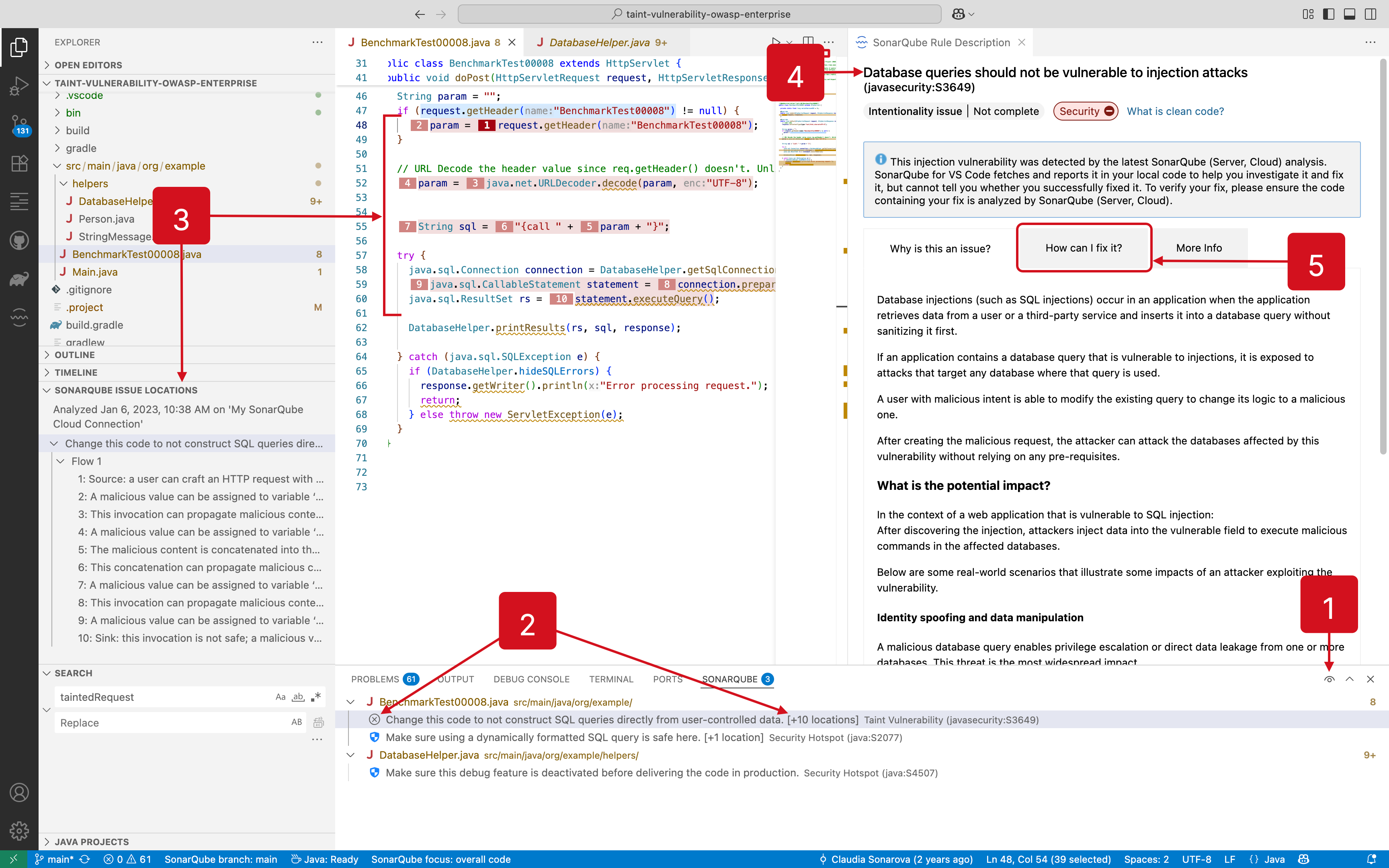
Injection vulnerabilities are distinguished in the **SONARQUBE** panel as shown in the following image. Learn how to fix your injection vulnerability by using the tooltip options:
1. Note that your issue list might be collapsed depending on the new code period that is activated when selecting **Focus on New Code**. See the [New code](/sonarqube-for-vs-code/using/new-code.md#setting-your-focus-on-new-code) article for more information.
2. In the **SONARQUBE** panel, your taint vulnerabilities are easily identifiable by looking at the  identifying badge. You will also see how many locations this vulnerability occupies.
3. Select one of your taint vulnerabilities to focus the code editor and open the **SONARQUBE ISSUE LOCATIONS** view.
4. Selecting an issue will also open the **SonarQube Rule Description** view.
5. Find more information under the **How can I fix it?** tab.
Please see the documentation about [Injection vulnerabilities](/sonarqube-for-vs-code/using/taint-vulnerabilities.md) for more information about working with these particular security issues.
## Marking issues
When running SonarQube for VS Code in connected mode with SonarQube Server 10.2 and newer, it is possible to mark issues before submitting your code for PR analysis.
To mark an issue, go to your issue in the code editor or the **PROBLEMS** panel and select the lightbulb to find the **Quick Fix** menu. Then select **SonarQube: Resolve issue violating rule \`**<*your rule>***\` as…** and choose either **Accepted** or **False positive** to resolve the new issue. Note that the **Quick Fix** menu is only available in the lightbulb next to your issue in the code editor.
{% hint style="info" %}
When running in connected mode with SonarQube Server 10.4 or newer, **Won’t Fix** becomes **Accept**.
{% endhint %}
Marking an issue can be applied to both *new issues* and *known issues*. Marks made on known issues will be reflected on the SonarQube Server server within a few minutes; marks made on new issues will be reflected on the server when a new analysis is run. The option to mark an issue as resolved will not appear if you are connected to an unsupported version of SonarQube Server.
To unmark *all issues not yet known in SonarQube Server*, open the **VS Code Command Palette** and run the command `SonarQube: Reopen Local Issues for current file`. This command will only affect new issues that were marked before an analysis was run on the server.
### Requirements for marking issues
* SonarQube for VS Code 3.21 or newer.
* Running in connected mode with SonarQube Server 10.2 or newer.
* In SonarQube Server, the **Administer Issues** permission must be granted to the user(s).
{% hint style="info" %}
[Security hotspots](/sonarqube-for-vs-code/using/security-hotspots.md) and [Injection vulnerabilities](/sonarqube-for-vs-code/using/taint-vulnerabilities.md) found also on SonarQube Server, Cloud, or on SonarQube Community Build can be marked using different terminology regarding the issue’s status. Please see the dedicated documentation for fixing each of those issue types.
{% endhint %}
---
# Agent Instructions
This documentation is published with GitBook. GitBook is the documentation platform designed so that both humans and AI agents can read, navigate, and reason over technical content effectively. Learn more at gitbook.com.
## Querying This Documentation
If you need additional information that is not directly available in this page, you can query the documentation by asking a question.
Perform an HTTP GET request on the following URL with the `ask` and `goal` query parameters:
```
GET https://docs.sonarsource.com/sonarqube-for-vs-code/using/fixing-issues.md?ask=&goal=
```
`ask` is the immediate question: it should be specific, self-contained, and written in natural language.
`goal` is what the user is ultimately trying to achieve, the reason they need the answer. Sharing it helps GitBook give you a better, more relevant answer. A goal is most helpful when it describes the outcome the user wants rather than restating the question. For example, with `ask=how do I create an API token`, a goal like `automate deployments from our CI pipeline` lets GitBook tailor the answer to that use case.
The response will contain a direct answer to the question and relevant excerpts and sources from the documentation.
Use this mechanism when the answer is not explicitly present in the current page, you need clarification or additional context, or you want to retrieve related documentation sections.