> For the complete documentation index, see [llms.txt](https://docs.sonarsource.com/llms.txt). Markdown versions of documentation pages are available by appending `.md` to page URLs; this page is available as [Markdown](https://docs.sonarsource.com/sonarqube-server/2026.1/extension-guide/developing-a-plugin/executable-lines.md).
# Executable lines
Internal guidelines to define executable lines for a language. This page is for SonarQube Server 2026.1.
These are the guidelines that Sonar uses internally when defining executable lines for a language. Community plugins are not required to adhere to these guidelines. They are provided here only in case they are useful.
## Things that are executable
Executable lines data is used to calculate missing test coverage for files that are not included in coverage reports. Ideally, executable line counts will be at or just under what coverage engines would calculate.
Generally, each line containing a statement should count as an executable line, with the exception that compound statements ({}) are ignored, although their contents are not. So, for example:
```css-79elbk
void doTheThing () // +0
{ // +0
String fname="Finn"; // +1
etc(); // +1
} // +0
```
## Things that are ignored
### !Statement: +0
Since some coverage engines mark these things as executable, it’s worth stating explicitly that we will ignore them:
* lines containing only punctuation.
* the method signature of a method definition.
### Imports, Declarations: +0
Imports, package and namespace statements, declarations, and a few other things demonstrated below are ignored.
```css-79elbk
package foo; // +0
namespace bar { // +0
...
}
import java.util.ArrayList; // +0
#include // +0
public interface FooFace { // +0
void doFoo(); // +0
}
public class Foo1 implements FooFace { // +0
private String name; // +0
}
struct PairWithOperator { // +0
int x; // +0
int y; // +0
bool operator==(PairWithOperator rhs) const { // +0
return x == rhs.x && y == rhs.y; // +1
}
}
class C {
C(const C&) =default; // +0 (explicit inheritance of parent method)
}
using Vec = std::vector>; // +0
static { // +0
...
}
01 ERROR-MESSAGE. *> +0
02 ERROR-TEXT PIC X(132) OCCURS 10 TIMES *> +0
INDEXED BY ERROR-INDEX.
77 ERROR-TEXT-LEN PIC S9(9) COMP VALUE +132. *> +0
```
### Location
The presence of executable code on a line makes the entire line executable. If a statement is split over multiple lines, the line to be marked executable is the first one with executable code. Given that, a `for` loop is considered executable:
```css-79elbk
for // +1
( // +0
int i=0; // +0
i < 10; // +0
i++ // +0
) // +0
{ // +0
}
```
Regardless of the number of lines across which nested statements are spread, the executable line count should only be incremented by one, since typically the execution of one naturally follows from the other.
```css-79elbk
foo(1, bar()); // +1
foo(1, // +1
bar()); // +0
```
We ignore here the possibility that `bar()` could throw an exception, preventing `foo` from being executed.
## Exceptions
### Python
`# pragma: no cover` exempts a block from coverage. For example:
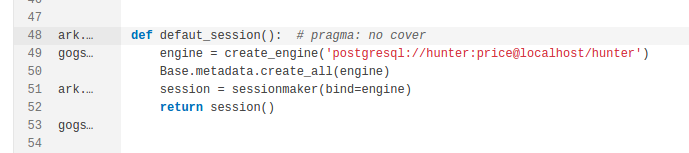
Exempt a block of Python code from coverage
### JavaScript
We mark variable declarations as executable. For example:
```css-79elbk
var a; // +1
```
---
# Agent Instructions
This documentation is published with GitBook. GitBook is the documentation platform designed so that both humans and AI agents can read, navigate, and reason over technical content effectively. Learn more at gitbook.com.
## Querying This Documentation
If you need additional information that is not directly available in this page, you can query the documentation by asking a question.
Perform an HTTP GET request on the following URL with the `ask` and `goal` query parameters:
```
GET https://docs.sonarsource.com/sonarqube-server/2026.1/extension-guide/developing-a-plugin/executable-lines.md?ask=&goal=
```
`ask` is the immediate question: it should be specific, self-contained, and written in natural language.
`goal` is what the user is ultimately trying to achieve, the reason they need the answer. Sharing it helps GitBook give you a better, more relevant answer. A goal is most helpful when it describes the outcome the user wants rather than restating the question. For example, with `ask=how do I create an API token`, a goal like `automate deployments from our CI pipeline` lets GitBook tailor the answer to that use case.
The response will contain a direct answer to the question and relevant excerpts and sources from the documentation.
Use this mechanism when the answer is not explicitly present in the current page, you need clarification or additional context, or you want to retrieve related documentation sections.