> For the complete documentation index, see [llms.txt](https://docs.sonarsource.com/llms.txt). Markdown versions of documentation pages are available by appending `.md` to page URLs; this page is available as [Markdown](https://docs.sonarsource.com/sonarqube-server/project-administration/adjusting-analysis/configuring-new-code-calculation.md).
# Configuring new code calculation
Configuring your project’s new code definition in SonarQube Server 2026.5.
By default, your project applies the baseline for new code (global-level new code definition). This means it consistently uses the baseline for new code. Consequently, any modifications to the baseline will automatically be applied to your project. You can apply a specific new code definition for your project instead.
By default, any branch in your project applies the project’s new code definition. You can apply a specific new code definition instead.
For more information, see [Quality standards and new code](/sonarqube-server/user-guide/about-new-code.md).
## Setting a specific new code definition for your project or branch
As a project administrator, you can set the new code definition for your project or branch in the UI (except the Specific analysis option) or using the Web API, at creation time or anytime later as explained below.
{% hint style="info" %}
For more compliance with the Sonar recommended settings, the Specific analysis option can only be set using the Web API, as it would require frequent user action to be kept up to date.
{% endhint %}
{% hint style="info" %}
You can configure the Reference branch option through an analysis parameter on the CI/CD host. See **Additional setup and recommendations > If using Reference branch option** below.
{% endhint %}
### In the SonarQube Server
#### New code definition for a project
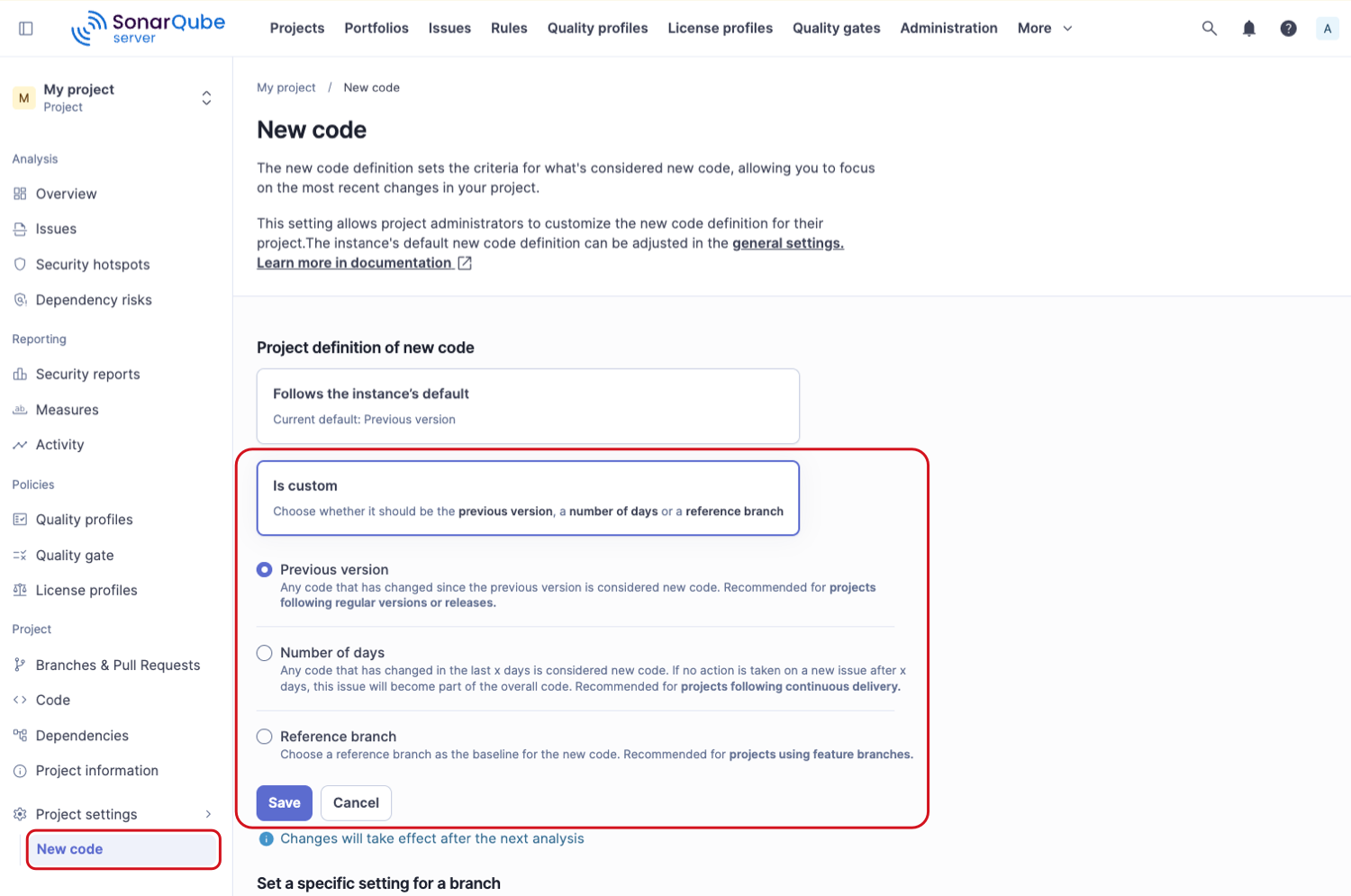
To set a specific new code definition for your project or branch in the SonarQube:
1\. Retrieve your project. See [Retrieving projects](/sonarqube-server/user-guide/viewing-projects/retrieving-projects.md) for details.
2\. Go to **Project Settings > New Code**.
3\. In **Project definition of new code** section, select **Custom** and then the option you want to apply to your project. The options are **Previous version**, **Number of days**, and **Reference branch**.
#### New code definition for a branch
To apply a specific setting to a branch:
1. Navigate to the **Set a specific setting for a branch** section at the bottom of the page.
2. In the **Actions** column of the branch, select the edit icon. The **New Code for \** dialog opens.
3. Select the new code option you want to apply to the branch. The options are **Previous version**, **Number of days**, and **Reference branch**.
4. Click **Save**.
### Via the Web API
Use the api/new\_code\_periods/set endpoint by specifying:
* To set a specific definition for your project: the project
* To set a specific definition for a branch: the project and branch.
## Additional setup and recommendations
Make sure to follow the recommendations about the [Checked-out code](/sonarqube-server/2025.2/analyzing-source-code/scanners/scanner-environment/verifying-code-checkout-step.md) and [SCM integration](/sonarqube-server/2025.2/analyzing-source-code/scm-integration.md).
### If using any option except Reference branch
When using any new code option other than Reference branch, we recommend completing your merges using the fast-forward option without a merge commit; examples include GitHub’s squash and merge or rebase and merge options. That way, blame for merged commits will always have a more recent commit date.
### If using Previous version option
The current version of a project is determined in different ways depending on the build system:
* If the analysis is done using the [SonarScanner for Maven](/sonarqube-server/analyzing-source-code/scanners/sonarscanner-for-maven.md), then SonarQube Server reads the version from the `pom.xml` file.
* If the analysis is done with the [SonarScanner for Gradle](/sonarqube-server/analyzing-source-code/scanners/sonarscanner-for-gradle.md) then SonarQube Server reads the version from the `build.gradle` file.
* In all other cases, you must explicitly specify the version by setting the analysis parameter `sonar.projectVersion`. For more information, see [Parameters not settable in the UI](/sonarqube-server/analyzing-source-code/analysis-parameters/parameters-not-settable-in-ui.md#project-information).
### If using Reference branch option
To make the Reference branch option work properly:
* The same branch name should be used in the SCM repository and SonarQube.
* The reference branch is fetched in the CI/CD host’s local repository (This is usually done through the cloning of the remote repository by the CI pipeline).
* The code in the CI/CD host’s local repository matches the code in the remote repository.
You can use the `sonar.newCode.referenceBranch` property to apply the Reference branch option to the analysis of a branch, overriding the global and project-level new code definition set in the UI. This property specifies the reference branch value. This setting is particularly useful during the first analysis when the branch to be analyzed does not exist yet in SonarQube (i.e. you cannot set a new code definition for this branch in SonarQube).
## Related pages
* [Quality standards and new code](/sonarqube-server/user-guide/about-new-code.md)
* [New code definition](/sonarqube-server/instance-administration/analysis-functions/setting-new-code-definition-at-global-level.md) at the instance level
---
# Agent Instructions
This documentation is published with GitBook. GitBook is the documentation platform designed so that both humans and AI agents can read, navigate, and reason over technical content effectively. Learn more at gitbook.com.
## Querying This Documentation
If you need additional information that is not directly available in this page, you can query the documentation by asking a question.
Perform an HTTP GET request on the following URL with the `ask` and `goal` query parameters:
```
GET https://docs.sonarsource.com/sonarqube-server/project-administration/adjusting-analysis/configuring-new-code-calculation.md?ask=&goal=
```
`ask` is the immediate question: it should be specific, self-contained, and written in natural language.
`goal` is what the user is ultimately trying to achieve, the reason they need the answer. Sharing it helps GitBook give you a better, more relevant answer. A goal is most helpful when it describes the outcome the user wants rather than restating the question. For example, with `ask=how do I create an API token`, a goal like `automate deployments from our CI pipeline` lets GitBook tailor the answer to that use case.
The response will contain a direct answer to the question and relevant excerpts and sources from the documentation.
Use this mechanism when the answer is not explicitly present in the current page, you need clarification or additional context, or you want to retrieve related documentation sections.