> For the complete documentation index, see [llms.txt](https://docs.sonarsource.com/llms.txt). Markdown versions of documentation pages are available by appending `.md` to page URLs; this page is available as [Markdown](https://docs.sonarsource.com/sonarqube-server/project-administration/setting-up-features/project-settings.md).
# Setting various features at project level
Changing and customizing your project’s settings in SonarQube Server 2026.5.
Project administration is accessible through the **Project Settings** menu of each project. Only project administrators can access project’s settings.
## PDF reports
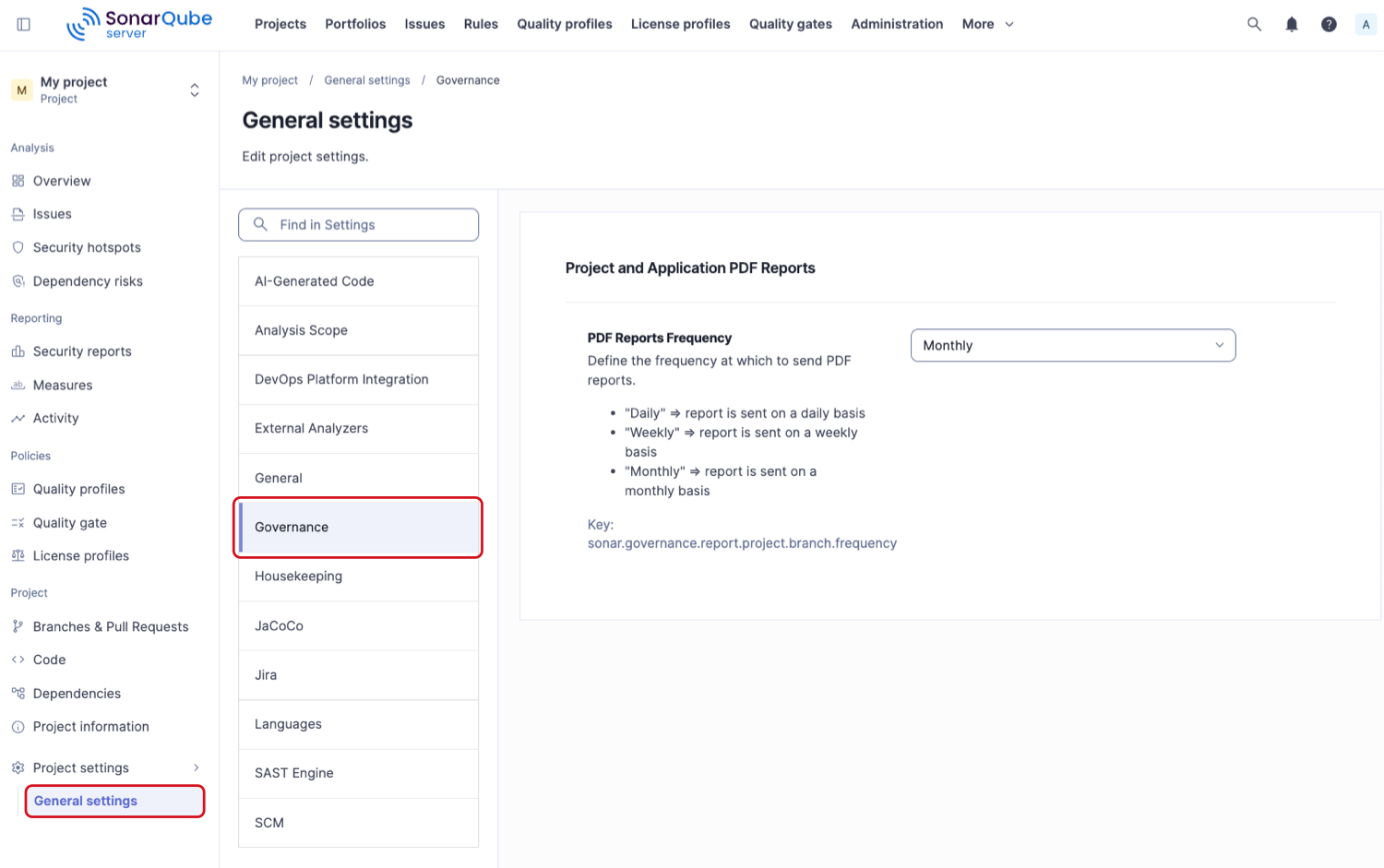
As a project administrator, you can change the PDF report subscription frequency of the project or application:
1. Retrieve your project. See [Retrieving projects](/sonarqube-server/user-guide/viewing-projects/retrieving-projects.md) for more details.
2. Go to **Project Settings** > **General Settings** > **Governance**.
3. Under **Project and Application PDF Reports**, select an option from the **PDF Reports Frequency** drop-down menu.
You have the following options for subscription frequency:
* **Daily**
* **Weekly**
* **Monthly (default)**
{% hint style="info" %}
Users can only download or subscribe to a PDF report for a permanent branch. To set a branch as permanent, go to *Your project* > **Project Settings** > **Branches and Pull Requests** and make sure that the **Keep when inactive** toggle is on for that branch.
{% endhint %}
## Changing your project's default issue assignee
When new issues are created during analysis, they are assigned to the last committer where the issue was raised. When it is not possible to identify the last committer, issues can be assigned to a default assignee if set at the global or project level. To set the default assigned for your project (this setting has precedence over the global-level setting):
1. Retrieve your project. See [Retrieving projects](/sonarqube-server/user-guide/viewing-projects/retrieving-projects.md) for more details.
2. Go to **Project Settings** > **General Settings > General**.
3. In **Issues > Default Assignee**, enter the user account.
## In-code issue resolution
You can enable usage of in-code issue resolution with sonar-resolve for your project. To do this, go to *Your project* > **Project Settings** > **General Settings** > **General** and activate the **Enable in-code issue resolution** setting. For more information on in-code issue resolution, see [Resolving issues in your code](/sonarqube-server/user-guide/issues/managing.md#resolving-in-code).
Admins can activate this setting by default on all projects. See [Various settings at the instance level](/sonarqube-server/instance-administration/analysis-functions/various-settings-at-the-instance-level.md#in-code-issue-resolution) for more information.
## Related pages
* [PDF reports](/sonarqube-server/instance-administration/system-functions/pdf-reports.md) (setup at the instance level)
* [Various settings at the instance level](/sonarqube-server/instance-administration/analysis-functions/various-settings-at-the-instance-level.md#changing-default-issue-assignee)
---
# Agent Instructions
This documentation is published with GitBook. GitBook is the documentation platform designed so that both humans and AI agents can read, navigate, and reason over technical content effectively. Learn more at gitbook.com.
## Querying This Documentation
If you need additional information that is not directly available in this page, you can query the documentation by asking a question.
Perform an HTTP GET request on the following URL with the `ask` and `goal` query parameters:
```
GET https://docs.sonarsource.com/sonarqube-server/project-administration/setting-up-features/project-settings.md?ask=&goal=
```
`ask` is the immediate question: it should be specific, self-contained, and written in natural language.
`goal` is what the user is ultimately trying to achieve, the reason they need the answer. Sharing it helps GitBook give you a better, more relevant answer. A goal is most helpful when it describes the outcome the user wants rather than restating the question. For example, with `ask=how do I create an API token`, a goal like `automate deployments from our CI pipeline` lets GitBook tailor the answer to that use case.
The response will contain a direct answer to the question and relevant excerpts and sources from the documentation.
Use this mechanism when the answer is not explicitly present in the current page, you need clarification or additional context, or you want to retrieve related documentation sections.