> For the complete documentation index, see [llms.txt](https://docs.sonarsource.com/llms.txt). Markdown versions of documentation pages are available by appending `.md` to page URLs; this page is available as [Markdown](https://docs.sonarsource.com/sonarqube-server/user-guide/viewing-reports/portfolios.md).
# Portfolios
In SonarQube Server 2026.5, portfolios allow you to track releasability and ratings information for multiple projects.
*Portfolios are available starting in* [*Enterprise edition*](https://www.sonarsource.com/plans-and-pricing/enterprise/)*.*
## Retrieving a portfolio
To retrieve a portfolio:
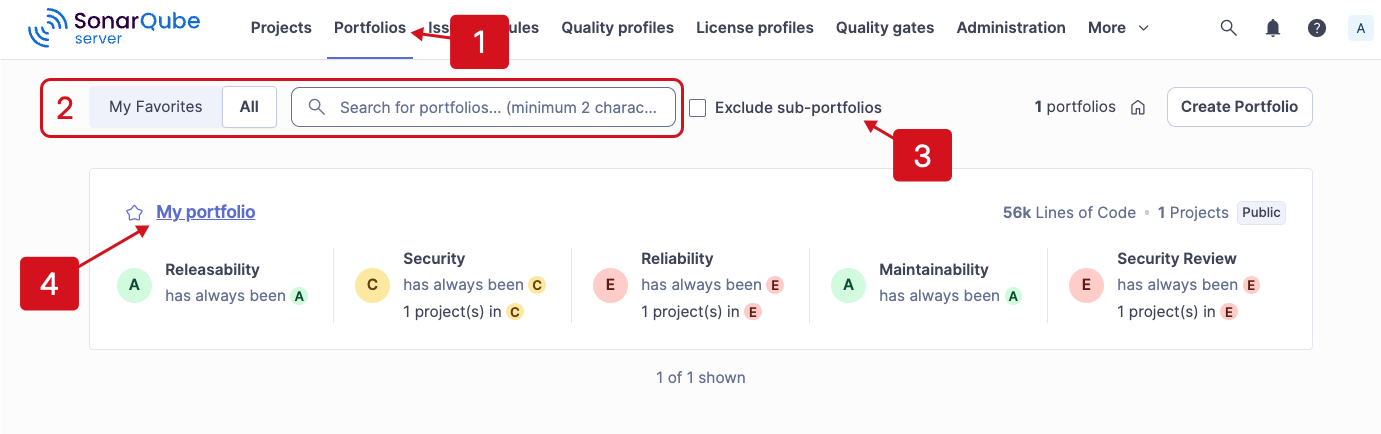
1. Go to **Portfolios**.
2. Filter the list of portfolios by **My Favorites**, **All** or search for your portfolio by its name.
3. Select **Exclude sub-portfolios** to filter the results to include top level portfolios only.
4. Select your portfolio from the list of results. Once selected the portfolio **Overview** page opens.
## Portfolio overview page
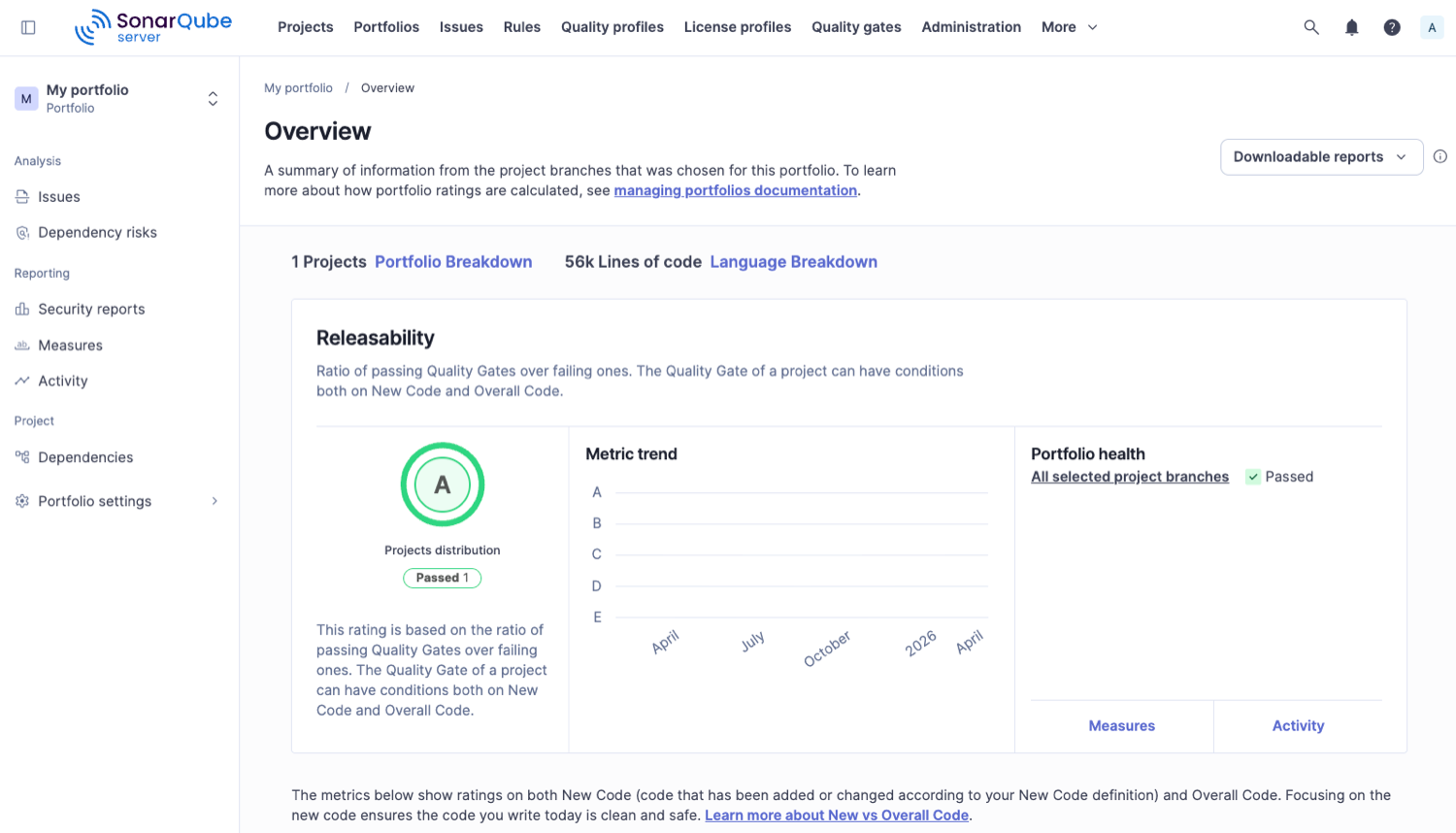
The portfolio **Overview** page is the central place for managers and tech leads to keep an eye on the releasability of the projects under their supervision. **Releasability** is based on the projects’ quality gates included in the portfolio. Each portfolio home page offers an aggregate view of the releasability status of all projects in the portfolio.
Depending on the configuration of your SonarQube Server instance, the portfolio report is generated with metrics either from [Standard Experience](/sonarqube-server/instance-administration/analysis-functions/instance-mode/standard-experience.md) or [MQR mode](/sonarqube-server/instance-administration/analysis-functions/instance-mode/mqr-mode.md).
At the top of the page, you can see the overall releasability of the portfolio, a graph showing the releasability trend, and the number of project branches that are failing and passing their quality gate.
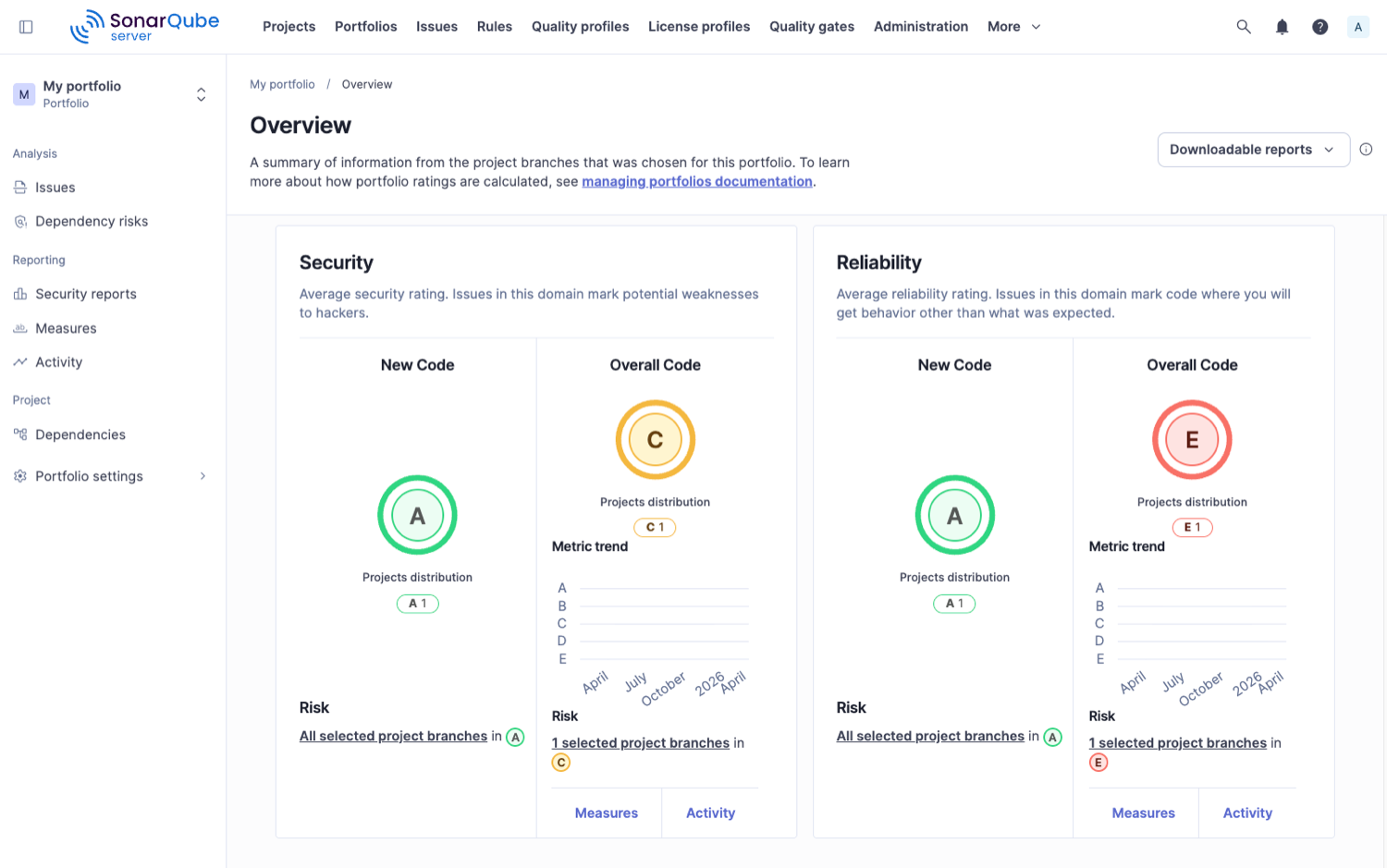
**Reliability**, **Security** (in MQR Mode) or **Security Vulnerabilities** (in Standard Experience), **Security** **Review,** and **Maintainability** ratings show the portfolio’s overall health, both for new code and overall code.
Below the new code rating for each metric, you see how many project branches are doing well and how many are at risk.
Below the overall code rating, a graph showing the trend for each metric is displayed, along with the number of at risk project branches.
## Rating conversion
Reliability, Security (in MQR Mode) or Security Vulnerabilities (in Standard Experience), Security Review, and Maintainability ratings for a portfolio are calculated as the average of the ratings for all projects included in the portfolio.
SonarQube Server converts each project’s letter rating to a number, calculates an average number for the projects in the portfolio, and converts that average to a letter rating. Averages ending with .5 are rounded up resulting in the "lower" of the two possible ratings, so an average of 2.5 would be rounded up to 3 and result in a "C" rating).
This gives a *problem density* measure on the four axes of Reliability, Security (in MQR Mode) or Security Vulnerability (in Standard Experience), Security Review, and Maintainability for your portfolio.
Rating conversion: E->5, D->4, C->3, B->2, A->1
Releasability
* The releasability rating is based on the proportion of projects in the portfolio that have passed their quality gate. The rating is as follows:\
**A**: > 80%\
**B**: > 60% and <= 80%\
**C**: > 40% and <= 60%\
**D**: > 20% and <= 40%\
**E**: <= 20%
* At the project level: The state of the quality gate associated with the project can be passed or failed.
Security
* The average security rating of all projects in the portfolio.
* At the project level: The security rating is related to issues that mark potential weaknesses to hackers. The rating is as follows:\
**A**: 0 vulnerability\
**B**: at least one minor vulnerability\
**C**: at least one major vulnerability\
**D**: at least one critical vulnerability\
**E**: at least one blocker vulnerability
Reliability
* The average reliability rating of all projects in the portfolio.
* At the project level: The reliability rating is related to issues that mark code where you will get behavior other than what was expected. The rating is as follows:\
**A**: 0 bugs\
**B**: at least one minor bug\
**C**: at least one major bug\
**D**: at least one critical bug\
**E**: at least one blocker bug
Maintainability
* The average maintainability rating of all projects in the portfolio.
* At the project level: The maintainability rating is related to issues that mark code that will be more difficult to update competently than it should. The maintainability rating is based on the technical debt ratio value (the ratio between the cost to develop the software and the cost to fix it). The default rating is as follows:\
**A**: <= 0.05\
**B**: > 0.05 and <= 0.1\
**C**: > 0.1 and <= 0.20\
**D**: > 0.2 and <= 0.5\
**E**: > 0.5
Security review
{% hint style="info" %}
Security Hotspots are being phased out. Rules that previously raised hotspots now raise vulnerabilities (in Standard Experience) or security issues (in MQR Mode).
{% endhint %}
* The average security review rating of all projects in the portfolio.
* At the project level: The security review rating is based on the percentage of reviewed Security Hotspots ([deprecated](/sonarqube-server/server-update-and-maintenance/release-notes.md#upgrade-notes)). Note that security hotspots are considered reviewed if they are marked as **Fixed** or **Safe**. The rating is as follows:\
**A**: >= 80%\
**B**: >= 70% and <80%\
**C**: >= 50% and <70%\
**D**: >= 30% and <50%\
**E**: < 30%
*Note: the portfolio **Overview** page is also available at the sub-portfolio level*
## Portfolio breakdown
The Portfolio Breakdown page shows ratings for your portfolio’s **Releasability**, **Security**, **Reliability**, **Maintainability**, and **Security Review** for new and overall code. Additional columns include **Lines of code** and **Last analysis**.
### Viewing your portfolio details
The **Portfolio details** section shows the aggregated portfolio rating. If the projects included in the portfolio have AI Code Assurance enabled on their quality gates, additional ratings appear for:
* **AI Code Assurance enabled projects**
* **Projects without AI Code Assurance enabled**
See the [AI Code Assurance](/agent-centric-development-cycle/ai-code-standards/ai-code-assurance.md) page for more information about enabling AI Code Assurance on your projects.
### Viewing the portfolio breakdown
The breakdown section includes a list of all projects, applications and nested portfolios included in your portfolio. The  label indicates that the item includes AI-generated code, as marked by a Quality Standard admin.
## Portfolio dashboards
Dashboards give you a configurable view of your portfolio alongside the Overview and Breakdown pages. The built-in **Portfolio health dashboard** surfaces key measures, trends, and risk breakdowns for the portfolio, and you can create custom dashboards from interactive widgets to track the metrics that matter most to your teams. You can sort and filter the data, and click values to drill down into the projects behind them. See [Portfolio dashboards](/sonarqube-server/user-guide/portfolio-dashboards.md) for more information.
## Related pages
* [Portfolio dashboards](/sonarqube-server/user-guide/portfolio-dashboards.md)
* [PDF reports](/sonarqube-server/user-guide/viewing-reports/pdf-reports.md)
* [Managing portfolios](/sonarqube-server/project-administration/managing-portfolios.md)
---
# Agent Instructions
This documentation is published with GitBook. GitBook is the documentation platform designed so that both humans and AI agents can read, navigate, and reason over technical content effectively. Learn more at gitbook.com.
## Querying This Documentation
If you need additional information that is not directly available in this page, you can query the documentation by asking a question.
Perform an HTTP GET request on the following URL with the `ask` and `goal` query parameters:
```
GET https://docs.sonarsource.com/sonarqube-server/user-guide/viewing-reports/portfolios.md?ask=&goal=
```
`ask` is the immediate question: it should be specific, self-contained, and written in natural language.
`goal` is what the user is ultimately trying to achieve, the reason they need the answer. Sharing it helps GitBook give you a better, more relevant answer. A goal is most helpful when it describes the outcome the user wants rather than restating the question. For example, with `ask=how do I create an API token`, a goal like `automate deployments from our CI pipeline` lets GitBook tailor the answer to that use case.
The response will contain a direct answer to the question and relevant excerpts and sources from the documentation.
Use this mechanism when the answer is not explicitly present in the current page, you need clarification or additional context, or you want to retrieve related documentation sections.