> For the complete documentation index, see [llms.txt](https://docs.sonarsource.com/llms.txt). Markdown versions of documentation pages are available by appending `.md` to page URLs; this page is available as [Markdown](https://docs.sonarsource.com/sonarqube-cloud/getting-started/first-analysis.md).
# Viewing your first analysis' results
Once you have successfully followed the in-product tutorial, SonarQube Cloud will automatically run its first analysis on your project.
If you have successfully followed the in-product tutorial, SonarQube Cloud will run its first analysis on your project.
The first analysis is always a *main branch analysis,* an analysis of the default branch of your repository.
From now on, a new analysis will be triggered every time you make a change to the main branch by direct push, pull request merge, or branch merge.
## Overview page
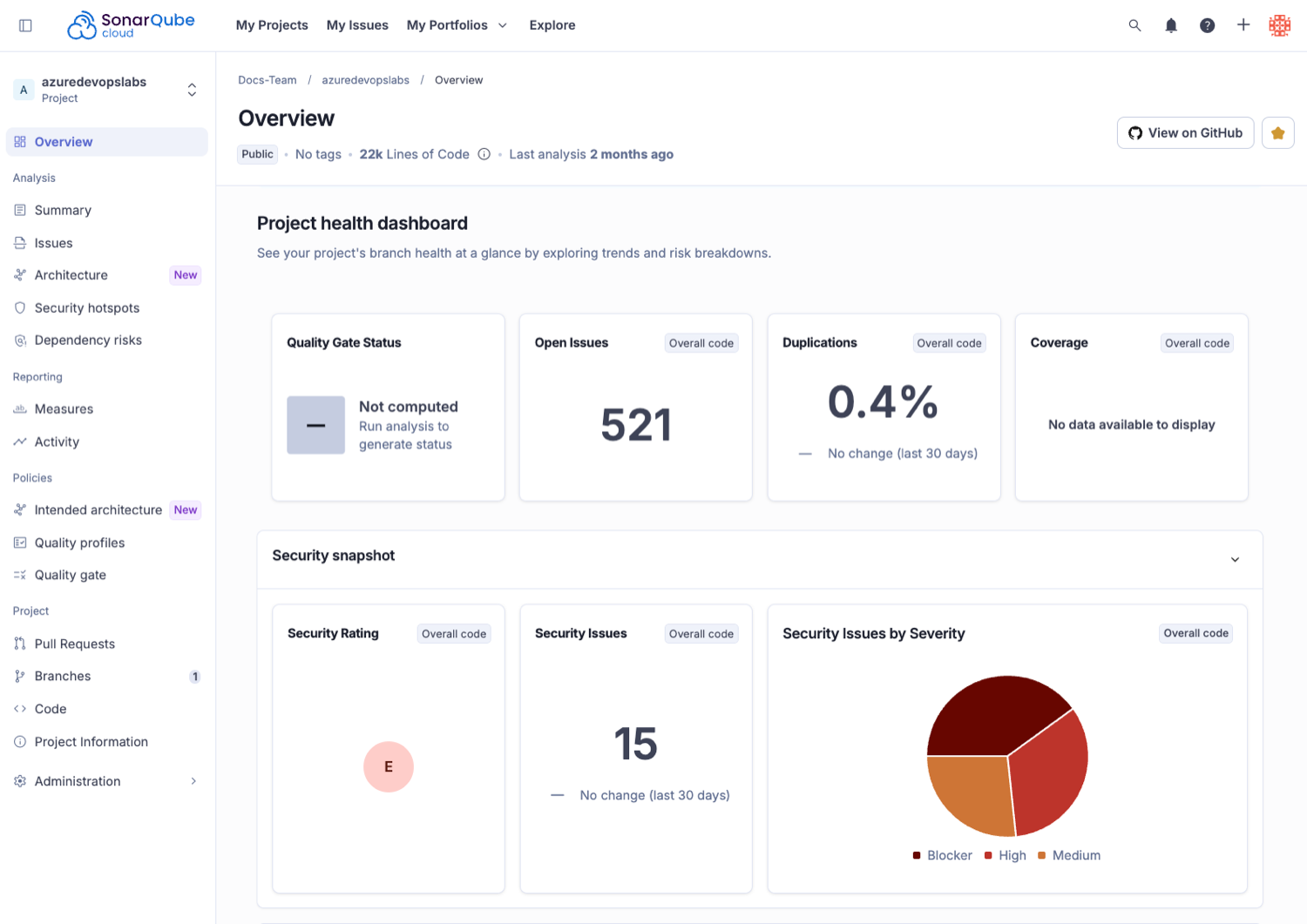
Once your analysis is completed a project Overview page opens, displaying the **Project health dashboard**, a built-in Sonar dashboard available in all plans. Custom dashboards and other built-in dashboard views are available in the [Enterprise](https://www.sonarsource.com/plans-and-pricing/sonarcloud/) plan.
The top row of the dashboard shows:
* **Quality gate status**: Passed, Failed or Not Computed.
{% hint style="info" %}
**The quality gate displays Not Computed because it needs to be configured.**
We strongly recommend set a new code definition by goin to *Your project* > **Administration** > **New Code**.
See the [Quality gates](/sonarqube-cloud/standards/quality-gates.md) and [Quality standards and new code](/sonarqube-cloud/standards/about-new-code.md) for more details. Once you set it up, push a change to the main branch. A new analysis will run, and the quality gate status will display either **Passed** or **Failed**.
{% endhint %}
* **Open issues**: Displays the number of issues found in the main branch.
* **Duplications:** Displays the percentage of main branch code that is duplicated.
* **Coverage**: Displays the percentage of testable code in the main branch that is covered by your test cases.
{% hint style="info" %}
**Coverage displays zero percent because it needs to be configured.**
Initially, your coverage will display zero percent because it requires configuration. To set it up, see the [Overview](/sonarqube-cloud/analyzing-source-code/test-coverage/overview.md) section.
Once it’s configured, push a change to the main branch to update the analysis. After the a new analysis is run, the coverage percentage will be displayed.
{% endhint %}
See [Retrieving projects](/sonarqube-cloud/managing-your-projects/retrieving-projects.md) for more information about the Project health dashboard and other project related information.
## Main branch
To view additional information about the most recent main branch analysis. Go to *Your project* > **Summary** page. Alternatively, you can go to *Your project* > **Branches** and select the main branch from the list of all the branches. See [Main branch analysis](/sonarqube-cloud/analyzing-source-code/branch-analysis/main-branch-analysis.md) for more information.
## Pull Requests
In addition to analyzing your main branch every time it changes, SonarQube Cloud also analyzes individual pull requests. These analyses run when a pull request is opened and on each change to the pull request branch. This all happens *before* you merge, letting you catch problems before they even get to the main branch.
To view a pull request analysis go to *Your project* > **Pull requests** and select your pull request from the list. See [Pull request analysis](/sonarqube-cloud/analyzing-source-code/pull-request-analysis.md) for more information.
## Branches
The **Branches** page displays all the non-pull request branches for which you have set up analysis. Go to *Your project* > **Branches** to view the list. Initially, only the main branch is listed here. But, you can configure other branches to be analyzed. Once a branch is configured, an analysis is run on every change to that branch. See [Branch analysis](/sonarqube-cloud/analyzing-source-code/branch-analysis/branch-analysis.md) and [Branch analysis setup](/sonarqube-cloud/analyzing-source-code/branch-analysis/branch-analysis-setup.md) for more information.
## Related pages
* [Retrieving projects](/sonarqube-cloud/managing-your-projects/retrieving-projects.md)
* [Main branch analysis](/sonarqube-cloud/analyzing-source-code/branch-analysis/main-branch-analysis.md)
* [Pull request analysis](/sonarqube-cloud/analyzing-source-code/pull-request-analysis.md)
* [Branch analysis](/sonarqube-cloud/analyzing-source-code/branch-analysis/branch-analysis.md)
* [Branch analysis setup](/sonarqube-cloud/analyzing-source-code/branch-analysis/branch-analysis-setup.md)
---
# Agent Instructions
This documentation is published with GitBook. GitBook is the documentation platform designed so that both humans and AI agents can read, navigate, and reason over technical content effectively. Learn more at gitbook.com.
## Querying This Documentation
If you need additional information that is not directly available in this page, you can query the documentation by asking a question.
Perform an HTTP GET request on the following URL with the `ask` and `goal` query parameters:
```
GET https://docs.sonarsource.com/sonarqube-cloud/getting-started/first-analysis.md?ask=&goal=
```
`ask` is the immediate question: it should be specific, self-contained, and written in natural language.
`goal` is what the user is ultimately trying to achieve, the reason they need the answer. Sharing it helps GitBook give you a better, more relevant answer. A goal is most helpful when it describes the outcome the user wants rather than restating the question. For example, with `ask=how do I create an API token`, a goal like `automate deployments from our CI pipeline` lets GitBook tailor the answer to that use case.
The response will contain a direct answer to the question and relevant excerpts and sources from the documentation.
Use this mechanism when the answer is not explicitly present in the current page, you need clarification or additional context, or you want to retrieve related documentation sections.