> For the complete documentation index, see [llms.txt](https://docs.sonarsource.com/llms.txt). Markdown versions of documentation pages are available by appending `.md` to page URLs; this page is available as [Markdown](https://docs.sonarsource.com/sonarqube-server/server-installation/plugins/install-a-plugin.md).
# Installing a plugin
Learn how to install or uninstall a plugin in SonarQube Server 2026.5.
You need to manually install plugins when using SonarQube Server (you cannot use the SonarQube Marketplace).
To see what plugins are available and which version is appropriate for your SonarQube Server, use the [Plugin version matrix](/sonarqube-server/server-installation/plugins/plugin-version-matrix.md), which is kept up to date with current plugin availability and compatibility.
{% hint style="warning" %}
Plugins are not provided by Sonar; therefore, you install them at your own risk. A SonarQube Server administrator needs to acknowledge this risk in the Marketplace before installing plugins or when prompted in SonarQube Server after installing a plugin manually.
{% endhint %}
## Installing a plugin
{% tabs %}
{% tab title="ZIP INSTALLATION" %}
We recommend installing SonarQube Server with the Docker image or the Helm chart. ZIP installation is still supported, but it will be removed in a future release.
* Download the plugin you want to install. The version needs to be compatible with your SonarQube version.
* Put the downloaded jar in `/extensions/plugins`, and remove any previous versions of the same plugins.
* Restart your SonarQube.
{% hint style="info" %}
In case of a Data Center edition:
* Plugins are not shared, meaning if you install/uninstall/upgrade a given plugin on one application node, you need to perform the same actions on the other application nodes.
* All application nodes must be stopped when installing, uninstalling, or upgrading a plugin.
{% endhint %}
{% endtab %}
{% tab title="DOCKER INSTALLATION" %}
When running SonarQube Server under Docker, any plugin you want to install must also be copied into the Docker volume you create during installation. See the [Installation overview](/sonarqube-server/server-installation/from-docker-image/installation-overview.md) article in our documentation for more details about creating the volume and container.
{% hint style="info" %}
Once SonarQube Server UI is up, you can encrypt sensitive properties stored in `/conf/sonar.properties`. See the [Sensitive settings](/sonarqube-server/instance-administration/security/encrypting-settings.md) page.
{% endhint %}
Let’s assume that your SonarQube docker container is called `sonarqube`. The easiest way to install manually a plugin in the container is the following.
* Check if an existing version of the plugin exists. Run `docker exec sonarqube bash -c 'ls "$SONARQUBE_HOME"/extensions/plugins'` to see the entire list of plugins that are installed manually.
* If a previous version of the plugin is listed, remove it using `docker exec sonarqube bash -c 'rm "$SONARQUBE_HOME"/extensions/plugins/'`
* Install the new plugin using `docker exec sonarqube bash -c 'wget -P "$SONARQUBE_HOME"/extensions/plugins/'`
* Restart the SonarQube docker container using `docker restart sonarqube`
Note that if you have followed the guidelines outlined on the [Prepare the Docker installation](/sonarqube-server/server-installation/from-docker-image/prepare-installation.md) page, the resulting plugin will be available in the `sonarqube_extensions` volume, which is attached to the `/extensions/plugins` folder.
{% hint style="info" %}
In case of a Data Center edition:
* Plugins are not shared, meaning if you install/uninstall/upgrade a given plugin on one application node, you need to perform the same actions on the other application nodes.
* All application nodes must be stopped when installing, uninstalling, or upgrading a plugin.
{% endhint %}
{% endtab %}
{% tab title="KUBERNETES INSTALLATION" %}
1. Download the appropriate plugin JAR file from a trusted source, ensuring it’s compatible with your SonarQube version.
2. Add the plugins section to your `values.yaml` file as illustrated below and use the `helm upgrade` command to apply the new chart.
```yaml
plugins:
install:
- "https://github.com/SonarOpenCommunity/sonar-cxx/releases/download/cxx-2.0.7/sonar-cxx-plugin-2.0.7.3119.jar"
```
Or use the `helm upgrade` command as illustrated below:
```sh
helm upgrade --install -n sonarqube sonarqube sonarqube/sonarqube \
--set "plugins.install={https://github.com/SonarOpenCommunity/sonar-cxx/releases/download/cxx-2.0.7/sonar-cxx-plugin-2.0.7.3119.jar}"
```
{% endtab %}
{% endtabs %}
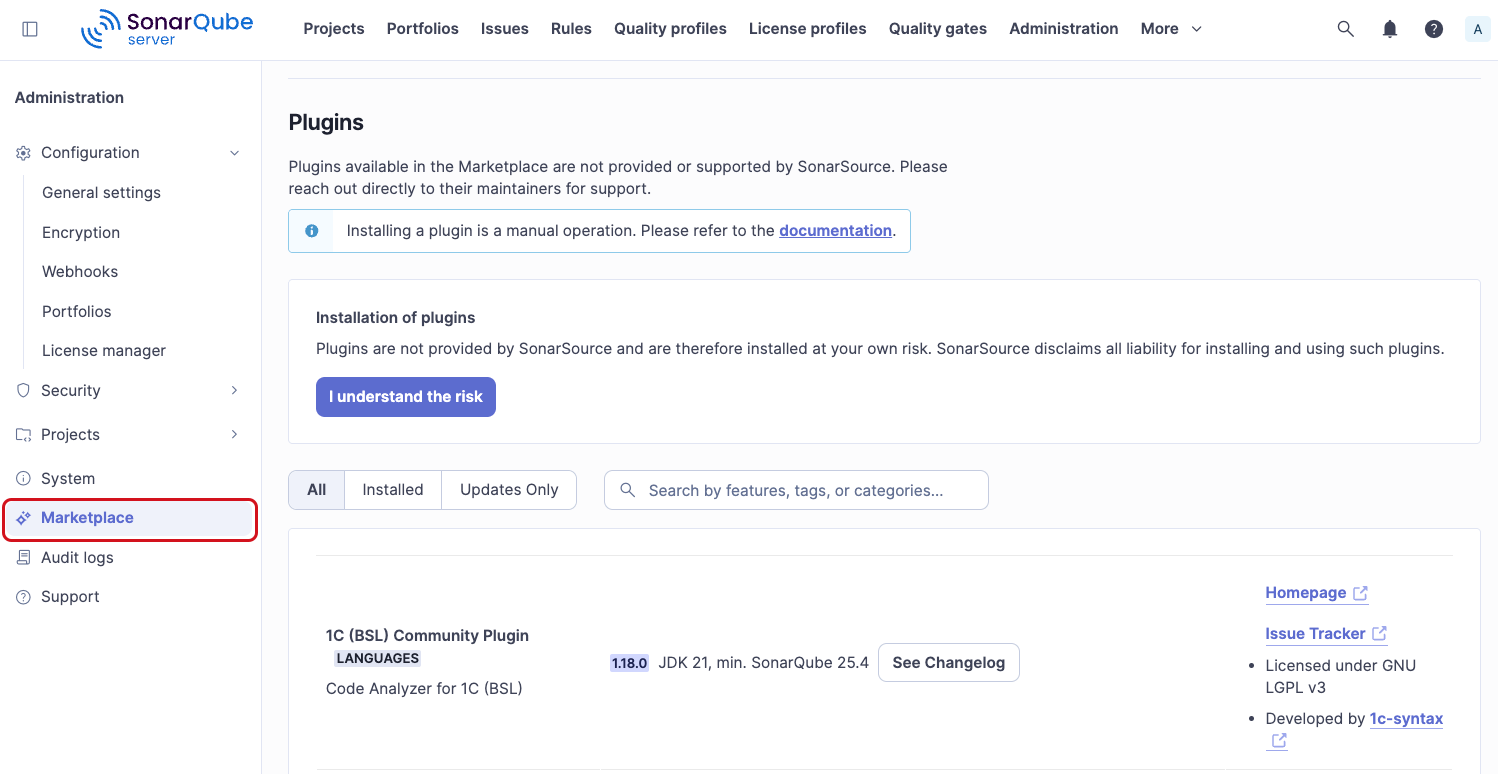
To verify the plugin installation, go to **Administration** > **Marketplace.**
## Uninstalling a plugin
To uninstall a plugin:
1. Delete the plugin from the `/extensions/plugins` folder.
2. Restart your SonarQube Server.
---
# Agent Instructions
This documentation is published with GitBook. GitBook is the documentation platform designed so that both humans and AI agents can read, navigate, and reason over technical content effectively. Learn more at gitbook.com.
## Querying This Documentation
If you need additional information that is not directly available in this page, you can query the documentation by asking a question.
Perform an HTTP GET request on the following URL with the `ask` and `goal` query parameters:
```
GET https://docs.sonarsource.com/sonarqube-server/server-installation/plugins/install-a-plugin.md?ask=&goal=
```
`ask` is the immediate question: it should be specific, self-contained, and written in natural language.
`goal` is what the user is ultimately trying to achieve, the reason they need the answer. Sharing it helps GitBook give you a better, more relevant answer. A goal is most helpful when it describes the outcome the user wants rather than restating the question. For example, with `ask=how do I create an API token`, a goal like `automate deployments from our CI pipeline` lets GitBook tailor the answer to that use case.
The response will contain a direct answer to the question and relevant excerpts and sources from the documentation.
Use this mechanism when the answer is not explicitly present in the current page, you need clarification or additional context, or you want to retrieve related documentation sections.