> For the complete documentation index, see [llms.txt](https://docs.sonarsource.com/llms.txt). Markdown versions of documentation pages are available by appending `.md` to page URLs; this page is available as [Markdown](https://docs.sonarsource.com/sonarqube-cloud/managing-your-projects/issues/in-devops-platform/github.md).
# Issues reported in GitHub
SonarQube Cloud reports issues on your GitHub pull requests. It can also display security issues as code scanning alerts in the GitHub interface.
## Pull request decoration
SonarQube Cloud provides issue reporting for GitHub pull requests. Besides the pull request analysis summary found in the Checks and Conversation tabs, you will also see issues reported as inline annotations directly within the Files changed tab as illustrated below.
From an inline annotation, you can:
* View the corresponding issue in SonarQube Cloud: copy-paste in your browser the **See more on** link below the annotation text.
* View the pull request analysis summary in SonarQube Cloud: select the **View details** button.\
If this button is not available, select the **Try the new experience** link in the top right corner of your pull request page as illustrated below.
{% hint style="info" %}
* As a project admin, you can disable the pull request inline annotations for your project. See [Configuring GitHub project binding](/sonarqube-cloud/managing-your-projects/administering-your-projects/devops-platform-integration/github.md#disabling-the-inline-annotations).
* Pull request decoration is only supported with a bound project and requires that pull request integration be correctly configured for your project. See [Configuring GitHub project binding](/sonarqube-cloud/managing-your-projects/administering-your-projects/devops-platform-integration/github.md#setting-up-pull-request-integration).
* If pull requests on a specific repository aren't decorated, check that the **SonarQubeCloud** GitHub app has access to that repository. See [Importing GitHub.com organization](/sonarqube-cloud/administering-sonarcloud/managing-organization/creating-organization/importing-github-organization.md#diagnosing-repository-access).
{% endhint %}
## Using the Remediation agent on your pull requests
The SonarQube Remediation Agent runs an independent review and analysis to help you fix reliability and maintainability issues found in your latest code. It focuses on issues in your backlog, discovered in your main branch analysis, and, for GitHub-bound projects, on issues found in your latest pull request (PR).
The agent uses the LLM provider key configured for your organization to generate fix suggestions in the background, and checks that the new code doesn't introduce new issues before offering the suggestion.
To enable and install the agent, check out the [Administer the Remediation Agent](/sonarqube-cloud/administering-sonarcloud/ai-features/administer-remediation-agent.md) page. To understand the agent's behavior and learn how to engage with the agent in your pull request, have a look at the [Pull request fix suggestions](/sonarqube-cloud/managing-your-projects/issues/with-ai-features/pull-request-fix-suggestions.md) and [Backlog fix suggestions](/sonarqube-cloud/managing-your-projects/issues/with-ai-features/backlog-fix-suggestions.md) pages.
## Code scanning alerts
{% hint style="info" %}
Code scanning alerts are not yet supported with GHE.com Cloud organizations.
{% endhint %}
With the [Enterprise](https://www.sonarsource.com/plans-and-pricing/) plan, when you analyze a project in SonarQube Cloud, the detected security issues are displayed on the GitHub interface as code scanning alerts. When you change the status of a security issue in the SonarQube interface that status change is immediately reflected in the GitHub interface. Similarly, if you change the status of a code scanning alert in GitHub, that change is reflected in SonarQube.
{% hint style="info" %}
To report code scanning alerts, the project must be bound and correctly set up. See [Configuring GitHub project binding](/sonarqube-cloud/managing-your-projects/administering-your-projects/devops-platform-integration/github.md) for more details.
{% endhint %}
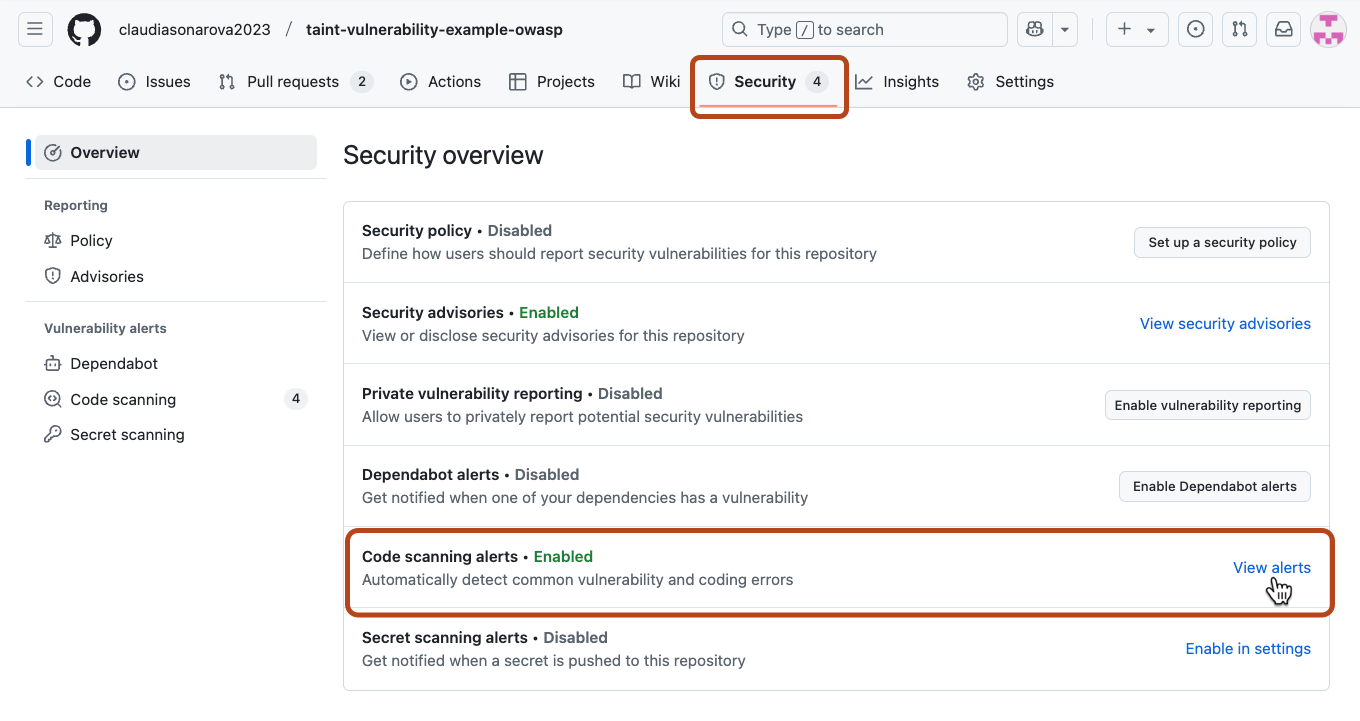
To view and manage your code scanning alerts:
1\. In GitHub, go to your repository’s **Security** > **Code scanning alerts** tab.
2\. Select **View alerts** to see the full list.
3\. When you change the status of a security vulnerability in the SonarQube Cloud interface that status change will be immediately reflected in the GitHub interface and vice versa.
## Related pages
* [Configuring GitHub project binding](/sonarqube-cloud/managing-your-projects/administering-your-projects/devops-platform-integration/github.md)
{% hint style="info" %}
For AI-powered review comments directly in pull requests, see [Gitar](https://docs.gitar.ai/features/code-review), a separate Sonar product.
{% endhint %}
---
# Agent Instructions
This documentation is published with GitBook. GitBook is the documentation platform designed so that both humans and AI agents can read, navigate, and reason over technical content effectively. Learn more at gitbook.com.
## Querying This Documentation
If you need additional information that is not directly available in this page, you can query the documentation by asking a question.
Perform an HTTP GET request on the following URL with the `ask` and `goal` query parameters:
```
GET https://docs.sonarsource.com/sonarqube-cloud/managing-your-projects/issues/in-devops-platform/github.md?ask=&goal=
```
`ask` is the immediate question: it should be specific, self-contained, and written in natural language.
`goal` is what the user is ultimately trying to achieve, the reason they need the answer. Sharing it helps GitBook give you a better, more relevant answer. A goal is most helpful when it describes the outcome the user wants rather than restating the question. For example, with `ask=how do I create an API token`, a goal like `automate deployments from our CI pipeline` lets GitBook tailor the answer to that use case.
The response will contain a direct answer to the question and relevant excerpts and sources from the documentation.
Use this mechanism when the answer is not explicitly present in the current page, you need clarification or additional context, or you want to retrieve related documentation sections.