> For the complete documentation index, see [llms.txt](https://docs.sonarsource.com/llms.txt). Markdown versions of documentation pages are available by appending `.md` to page URLs; this page is available as [Markdown](https://docs.sonarsource.com/sonarqube-cloud/getting-started-with-enterprise/setting-up-your-enterprise.md).
# Setting up your enterprise
This page explains how to set up your SonarQube Cloud Enterprise as part of the Getting started with Enterprise.
With the Enterprise license, you can group together SonarQube Cloud organizations from different DevOps platforms into an enterprise and benefit from many features. [Contact our team](https://www.sonarsource.com/products/sonarqube/cloud/contact-enterprise-sales/) to request an Enterprise license. Provide the maximum number of Lines of Code (LOC) you want to have in your enterprise. For more information, see [Subscription plans](/sonarqube-cloud/administering-sonarcloud/managing-subscription/subscription-plans.md#loc-based-pricing) for more information.
This page explains how to set up your enterprise from scratch.
{% hint style="info" %}
Currently, Sonar restricts each enterprise to a maximum of 200 organizations.
{% endhint %}
## Before you start
Create a SonarQube Cloud account through a supported DevOps login provider: GitHub.com, Bitbucket, GitLab, or Azure DevOps. See [Signing in via your DevOps platform service](/sonarqube-cloud/managing-your-account/signing-in.md#via-devops-platform). GHE.com and GitHub Enterprise Server (GHES) credentials cannot provide this initial login.
Use this DevOps platform account to create your enterprise. It becomes the initial enterprise administrator. To administer the enterprise before you configure Single Sign-On (SSO), use a DevOps platform account with the **Administer Enterprise** permission.
To complete enterprise creation, you must administer the first organization you add. Create an organization during setup, or use an account with the **Administer Organization** permission on an existing organization. An SSO account cannot create an enterprise.
## Step 1: Enter your enterprise details
1. Sign in to SonarQube Cloud with your DevOps platform account.
2. Select the **+** icon in the top right corner of SonarQube Cloud UI and select **Create new enterprise** in the menu.
3. In **License key**, enter the key you received from Sonar.
4. Enter the name and key of your enterprise.
5. Select **Next**.
## Step 2: Create or add the organizations
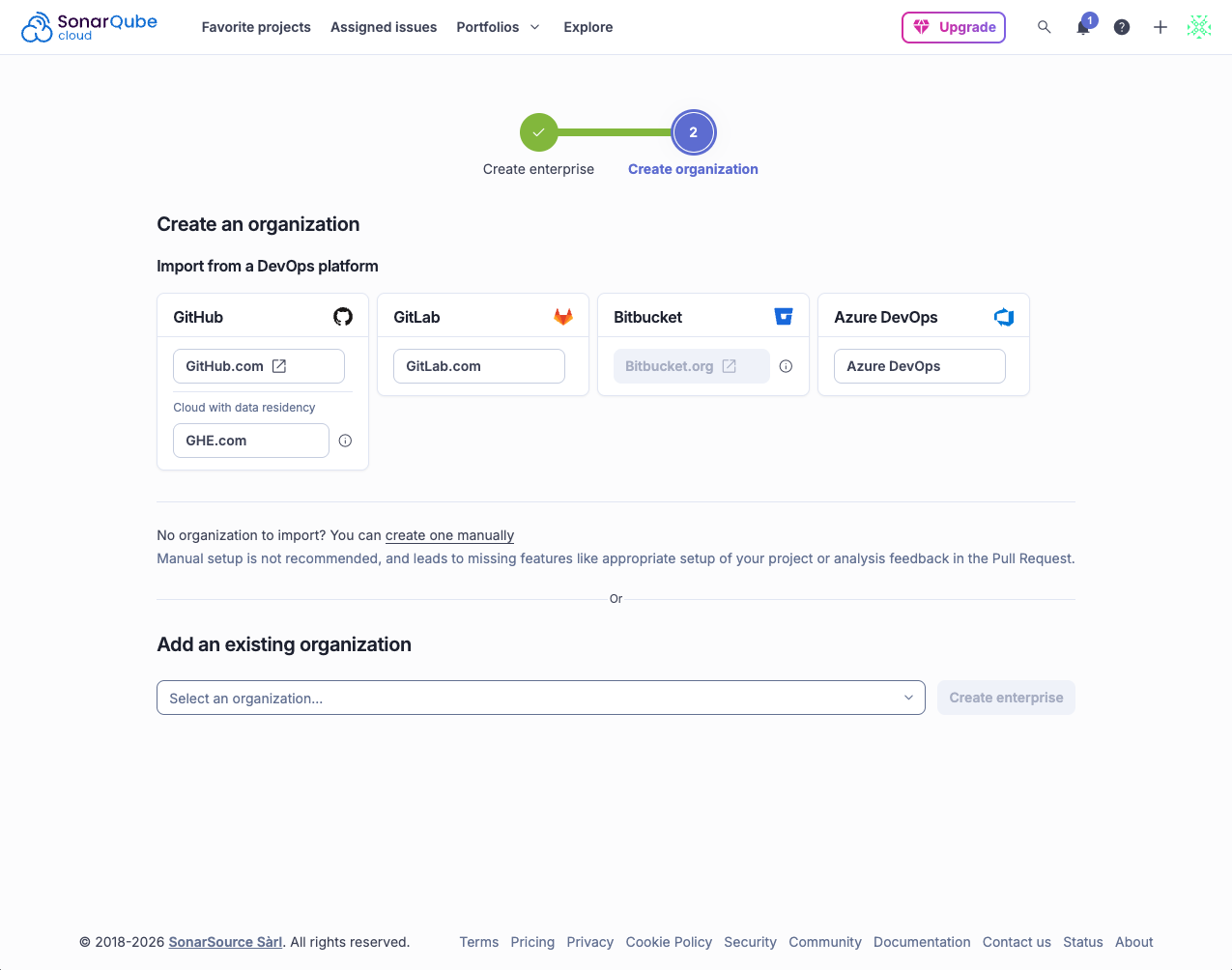
First, you must add your first organization. You can import and bind the corresponding DevOps platform organization, create an organization manually, or add an existing organization. Once an organization is added to your enterprise, it’s assigned the Enterprise plan.
* To import the organization from your DevOps platform, select your DevOps platform service in **Import from DevOps platform** and follow the instructions. For more information, see:
* [Importing GitHub.com organization](/sonarqube-cloud/administering-sonarcloud/managing-organization/creating-organization/importing-github-organization.md)
* [Importing GHE.com Cloud organization](/sonarqube-cloud/administering-sonarcloud/managing-organization/creating-organization/importing-ghecom-cloud-organization.md)
* [Importing GHES organization](/sonarqube-cloud/administering-sonarcloud/managing-organization/creating-organization/importing-ghes-organization.md)
* [Importing GitLab group](/sonarqube-cloud/administering-sonarcloud/managing-organization/creating-organization/importing-gitlab-group.md)
* [Importing Bitbucket workspace](/sonarqube-cloud/administering-sonarcloud/managing-organization/creating-organization/importing-bitbucket-workspace.md)
* [Importing Azure DevOps organization](/sonarqube-cloud/administering-sonarcloud/managing-organization/creating-organization/importing-azure-devops-organization.md)
* To add an existing organization, you must have the **Administer Organization** permission on that organization. Select the organization in **Add an existing organization**. For more information, see [Adding organizations to your enterprise](/sonarqube-cloud/administering-sonarcloud/managing-enterprise/adding-organizations-to-your-enterprise.md#add-existing-org).
{% hint style="warning" %}
If you add an existing Team plan organization to your enterprise, the organization’s Team plan subscription will be automatically cancelled and the organization will be moved to the Enterprise plan without a refund. Therefore, we recommend adding your organizations before their next billing date to avoid double charges.
{% endhint %}
At the end of the operation, select **Create Enterprise**.
The enterprise is created and you’re redirected to your enterprise’s **Organizations** page. You can now add other organizations to your enterprise. To do so, select **Create organization** to create a new organization, or **Add organization** to add an existing organization.
## Step 3: Set the enterprise permissions of users
As an Enterprise Admin, you can grant the Administer Enterprise and Create Portfolios permissions. For more information, check out the [Managing the enterprise-related permissions](/sonarqube-cloud/administering-sonarcloud/managing-enterprise/managing-the-enterprise-related-permissions.md) page.
To set the enterprise-related permissions of users, follow the instructions to [Retrieving and viewing your enterprise](/sonarqube-cloud/administering-sonarcloud/managing-enterprise/retrieving-and-viewing-your-enterprise.md). Once inside of your enterprise:
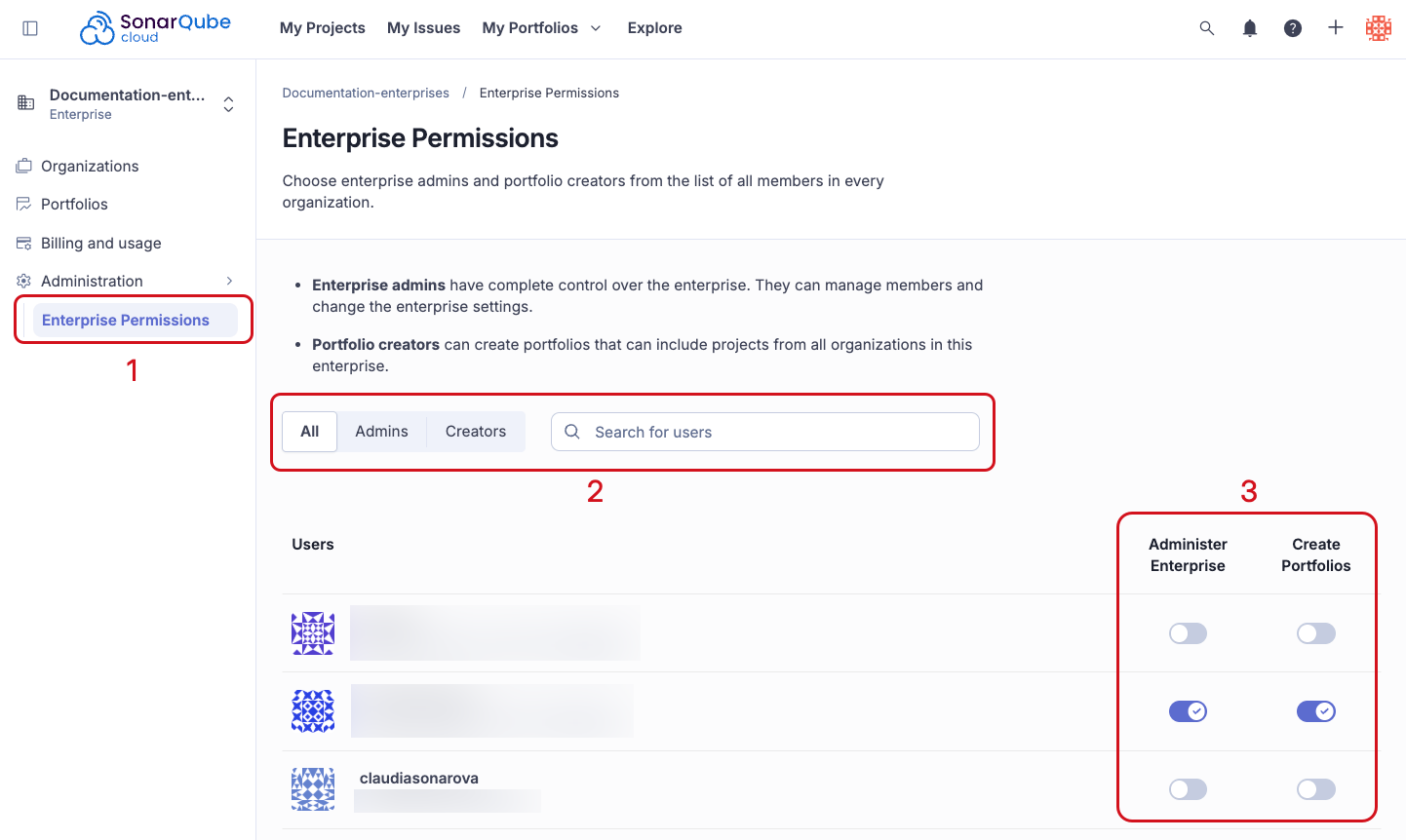
1. Navigate to **Administration** > **Enterprise Permissions**.
2. Filter the list by **Admins or Creators**, or search for specific users.
3. For each user, toggle the **Administer Enterprise** and **Create Portfolios** permissions.
## Step 4: Complete the enterprise onboarding
For each organization in your enterprise:
* If not already done, verify the group's default permissions on new projects. See the [Using permission templates](/sonarqube-cloud/administering-sonarcloud/managing-organization/manage-org-projects/manage-project-permissions/templates.md) page for more information.
* You can set project configurations at the organization level. The details are outlined in the [Performing global analysis setup](/sonarqube-cloud/administering-sonarcloud/managing-organization/setting-config-at-org-level.md) pages.
By default, all organizations share the enterprise LOC limit. You can allocate an individual LOC limit to one or several organizations within your enterprise; please check the [Managing the lines of code within your enterprise](/sonarqube-cloud/administering-sonarcloud/managing-enterprise/managing-the-lines-of-code-within-your-enterprise.md) page.
With the Enterprise license, you can now set up enterprise security features. For more information, see [Enterprise security](/sonarqube-cloud/administering-sonarcloud/enterprise-security.md).
If your enterprise includes GHE.com or GHES organizations, set up SSO for developer access. Importing these organizations does not configure user sign-in. See Signing in to SonarQube Cloud for [GHE.com](/sonarqube-cloud/administering-sonarcloud/managing-organization/creating-organization/importing-ghecom-cloud-organization.md#signing-in-to-sonarqube-cloud) or [GHES](/sonarqube-cloud/administering-sonarcloud/managing-organization/creating-organization/importing-ghes-organization.md#signing-in-to-sonarqube-cloud), and [Invite users to sign in](/sonarqube-cloud/administering-sonarcloud/enterprise-security/sso-and-provisioning/complete-setup.md).
## Step 5: Prepare developer IDE access
After the enterprise is created and organizations are attached, plan how developers will install SonarQube for IDE and bind their projects in [SonarQube for IDE](/sonarqube-cloud/analyzing-source-code/connected-mode.md). Connected mode applies your SonarQube Cloud quality profiles, rule selections, file exclusions, and issue states in the IDE.
SonarQube for IDE is available for [VS Code](https://docs.sonarsource.com/sonarqube-for-vs-code/), [IntelliJ](https://docs.sonarsource.com/sonarqube-for-intellij/), [Visual Studio](https://docs.sonarsource.com/sonarqube-for-visual-studio/), and [Eclipse](https://docs.sonarsource.com/sonarqube-for-eclipse/). If your organization manages VS Code extensions through a [VS Code Private Marketplace](https://code.visualstudio.com/blogs/2025/11/18/PrivateMarketplace), add SonarQube for VS Code to the private catalog before developer onboarding.
## Related pages
* [Viewing usage information](/sonarqube-cloud/getting-started-with-enterprise/viewing-billing-usage-info.md)
* [Adding organizations to your enterprise](/sonarqube-cloud/administering-sonarcloud/managing-enterprise/adding-organizations-to-your-enterprise.md)
* [Onboarding a new organization](/sonarqube-cloud/getting-started-with-enterprise/onboarding-new-org.md)
* [Recovering enterprise admin access](/sonarqube-cloud/administering-sonarcloud/managing-enterprise/recovering-enterprise-admin-access.md)
* [Permissions](/sonarqube-cloud/administering-sonarcloud/permissions.md)
## Related online learning
* :desktop: [Initial SonarQube Cloud Enterprise set up](https://www.sonarsource.com/learn/course/sonarqube-cloud/e390f0fe-64f4-4840-b74c-e63598af72f2/initial-sonarqube-cloud-enterprise-set-up)
---
# Agent Instructions
This documentation is published with GitBook. GitBook is the documentation platform designed so that both humans and AI agents can read, navigate, and reason over technical content effectively. Learn more at gitbook.com.
## Querying This Documentation
If you need additional information that is not directly available in this page, you can query the documentation by asking a question.
Perform an HTTP GET request on the following URL with the `ask` and `goal` query parameters:
```
GET https://docs.sonarsource.com/sonarqube-cloud/getting-started-with-enterprise/setting-up-your-enterprise.md?ask=&goal=
```
`ask` is the immediate question: it should be specific, self-contained, and written in natural language.
`goal` is what the user is ultimately trying to achieve, the reason they need the answer. Sharing it helps GitBook give you a better, more relevant answer. A goal is most helpful when it describes the outcome the user wants rather than restating the question. For example, with `ask=how do I create an API token`, a goal like `automate deployments from our CI pipeline` lets GitBook tailor the answer to that use case.
The response will contain a direct answer to the question and relevant excerpts and sources from the documentation.
Use this mechanism when the answer is not explicitly present in the current page, you need clarification or additional context, or you want to retrieve related documentation sections.